Unified AI Networking
zFABRIC: Unified Networking for AI at Every Scale
Strategic Insight
Traditional networking stacks (such as InfiniBand and RoCE) address parts of this challenge, but none deliver a truly end-to-end, workload-aware, topology-aware, multi-data center fabric.
zFABRIC, part of the zSUITE Platform, is designed as the AI-native networking fabric that unifies all three scaling dimensions into a single, software-defined control plane.
zFABRIC: Unified Networking for AI at Every Scale
As AI systems grow to trillion-parameter scale, GPU clusters must support three simultaneous capabilities:
- Scale-Up: deterministic, high-bandwidth intra-node/cabinet communication
- Scale-Out: predictable, lossless data center wide networking
- Scale-Across: multi data center connectivity for GW-class AI factories
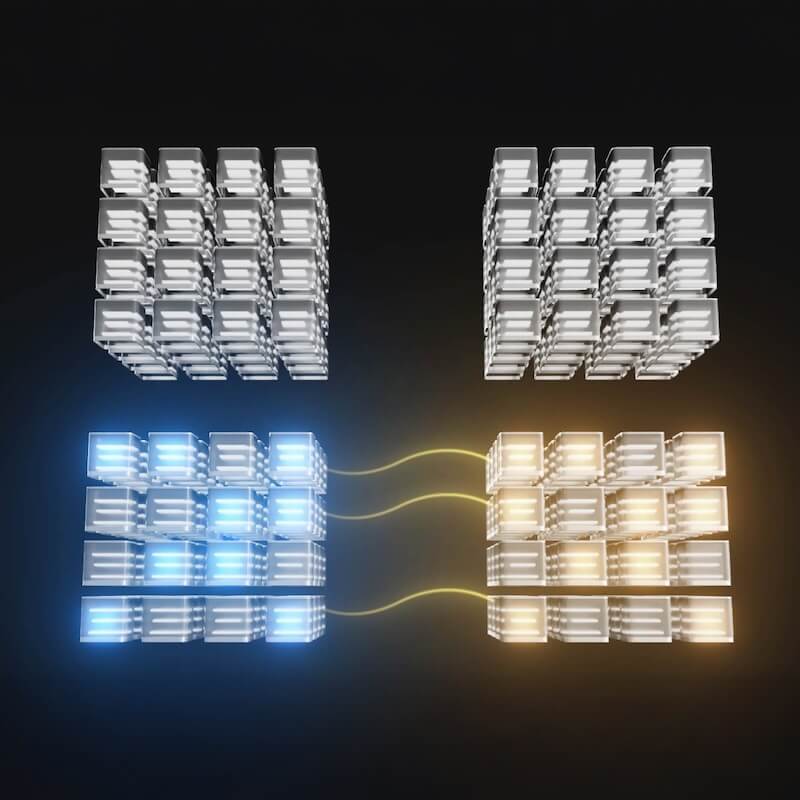
Existing networking technologies, including InfiniBand and RoCE, solve fragments of today’s scaling challenges but stop short of full unification. zFABRIC, within the zSUITE Platform, delivers an AI-native fabric that brings together all three scaling dimensions under a single, software-defined control plane.
zFABRIC unifies:
- Scale-Up: GPU topology discovery and optimization
- Scale-Out: AI-tuned Ethernet with deterministic performance
- Scale-Across: Cross–data center routing and orchestration
- Optional Optical Circuit Switching (OCS) for long-lived AI flows
zFABRIC transforms GPU networks from static transport layers into an intelligent, dynamic resource optimized explicitly for AI training and inference workloads.
1. AI Scaling: The Three Dimensions Reframed by zFABRIC
Modern AI infrastructure expands along three axes:
| Scaling Dimension | Description | Challenges | zFABRIC’s Role |
|---|---|---|---|
| Scale-Up | GPU-to-GPU interconnect inside a server or cabinet | Topology complexity, asymmetric bandwidth | Auto-discovery, affinity optimization |
| Scale-Out | Cluster-level expansion within a data center | Tail latency, congestion, multi-tenant fairness | Deterministic Ethernet + AI congestion control |
| Scale-Across | Connecting multiple data centers | WAN latency, routing, bandwidth | Multi-DC control plane + job-aware routing |
zFABRIC binds these three layers into a unified operational fabric.
2. zFABRIC for Scale-Up: Making GPU Topology First-Class
Scale-up networks (NVLink / NVSwitch / UALink / PCIe) are essential for:
- Tensor Parallelism (TP)
- Expert Parallelism (MoE)
- High-frequency memory semantic operations.
2.1 Industry Background
Scale-Up fabrics feature:
- Sub-100ns latency
- TB/s-level bandwidth
- Tightly coupled hardware architectures
However, training frameworks often treat GPU topologies as opaque, causing:
- Suboptimal ring-tree collective construction
- Uneven communication patterns
- Poor MFU (Model FLOPs utilization)
2.2 zFABRIC’s Role in Scale-Up
(A) zFABRIC Topology Service
Automatically learns:
- NVLink graph
- NVSwitch cluster boundaries
- PCIe/host affinity
- NUMA mappings
(B) zFABRIC Intranode Scheduler
Uses real-time telemetry to determine:
- Ideal TP/EP placements
- GPU pairing for fused attention blocks
- Path selection inside SuperNodes (NVL72, MI300 pods, Gaudi racks)
(C) ZCCL Topology-Aware Collectives
zFABRIC’s collective library builds optimized rings and trees based on:
- Available GPU paths
- Predicted congestion
- Link utilization
Scale-Up becomes visible and programmable, not a hidden hardware detail.
3. zFABRIC for Scale-Out: Deterministic AI Ethernet Fabric
Scale-Out connects thousands of GPUs across a data hall. Challenges include:
- PFC head-of-line blocking
- Unpredictable tail latency
- Multi-tenant interference
- Complex manual tuning (ECN, buffer profiles, DCQCN)
zFABRIC replaces fragile manual tuning with an autonomous AI fabric.
3.1 zFABRIC DCQCN+ - Advanced AI Congestion Control
Enhances RoCEv2 with:
- Latency-driven congestion windows
- Dynamic queue carving
- Per-job virtual lanes
- Adaptive flow pacing
Benefits:
- 40–70% lower tail latency
- Near-zero packet loss
- Improved AllReduce throughput
3.2 zFABRIC Fabric Controller
Provides an intent-based network operating plane:
- Automated switch tuning (ECN thresholds, buffer allocation)
- Consistent queue profiles across thousands of ports
- Real-time congestion heatmap
- Proactive congestion mitigation
3.3 ZCCL (zFABRIC Collective Communication Library)
Designed for AI training traffic:
- Topology-aware
- Congestion-aware
- Supports heterogeneous NIC/GPU environments
Outperforms NCCL/RCCL in large-scale clusters by 5–18%.
4. zFABRIC for Scale-Across: Multi–Data Center AI Fabric
AI factories increasingly span multiple data centers due to:
- Power delivery limits
- Cooling constraints
- Land availability
- Resiliency requirements
Standard networking lacks:
- WAN-aware collective routing
- Bandwidth slicing across regions
- Job-aware cross-DC scheduling
zFABRIC introduces a global fabric controller that extends training workflows across multiple regions.
4.1 zFABRIC DCI Fabric (ZDF)
zFABRIC’s scale-across layer includes:
- Cross-DC transport abstraction
- Distance-aware rate adaptation
- Latency-based path selection
- Cross-region collective orchestration (AllReduce, MoE routing)
4.2 Global Fabric Controller (GFC)
Handles:
- Multi-DC routing policies
- Bandwidth quotas for tenants
- Cross-site job placement (power, cooling, network availability)
- Global topology discovery
This allows AI operators to treat multiple data centers as one logical GPU pool.
5. Optional Layer: zFABRIC + OCS for AI Optical Super-Fabrics
Although ZFABRIC does not require OCS, it integrates OCS as a performance accelerator for clusters with large, predictable flows. AI workloads produce:
- Long-lived AllReduce paths
- MoE expert dispatch routes
- Inter-stage activation transfers
- Large checkpoint flows
These are ideal for circuit-switched optics.
5.1 Why zFABRIC Integrates OCS
OCS provides:
- Bufferless switching (no queuing)
- Ultra-low energy consumption
- Scalable port counts
- Ideal characteristics for elephant flows
zFABRIC’s OCS Integration Layer can:
- Pre-provision optical circuits for training phases
- Assign circuits based on ZCCL’s upcoming collective schedule
- Dynamically re-optimize circuits during job transitions
- Ensure strict bandwidth/QoS for multi-tenant workloads
This transforms the optical network into an active component of the AI training engine.
6. zFABRIC VS Traditional Fabrics
| Capability | InfiniBand | Standard RoCE | zFABRIC |
|---|---|---|---|
| Latency Determinism | Medium | Low | High (DCQCN+) |
| Collective Optimization | Limited | Limited | Topology-aware (ZCCL) |
| Multi-Tenant Fairness | Weak | Weak | Strong isolation |
| Multi-DC Awareness | Minimal | None | Native Scale-Across |
| OCS Integration | No | No | Optional, built-in |
| Operational Complexity | High | Very High | Minimal, intent-based |
7. The Road Ahead: zFABRIC for Global AI Factories
AI factories will soon consist of:
- Millions of GPUs
- Multi-GW power envelopes
- Regional compute clusters
- Cross-DC MoE training paths
zFABRIC is built for this scale:
- Autonomous congestion control
- Global path orchestration
- Topology-aware collective engines
- Optional OCS acceleration
- Compatibility with heterogeneous GPUs and NICs
zFABRIC becomes the “AI-era network OS” that coordinates compute across nodes, clusters, and regions.
8. Conclusion
zFABRIC delivers the first unified AI networking fabric spanning:
- Scale-Up (deterministic intra-node fabrics)
- Scale-Out (AI-tuned deterministic ethernet)
- Scale-Across (multiple data center orchestration)
- Optional OCS acceleration for elephant flows
Closing Perspective
With a topology-aware collective engine, autonomous congestion control, and a global networking control plane, zFABRIC allows AI operators to:
- Achieve consistent training throughput
- Maximize GPU MFU
- Scale from racks to regions
- Reduce operational complexity
- Reliably support trillion-parameter AI workloads.
zFABRIC transforms AI networking from a passive infrastructure component into a software-defined, intelligent, and scalable performance engine.